
The
Eastern Iowa DX Bulletin
Number
332, June 26, 2026
Craig Fastenow, KØCF, Editor
This is the final
issue
of
the Eastern Iowa DX Bulletin. It has been a pleasure
producing it for
all you dedicated DXers over the past six and a half years. I have also
recently tendered my resignation as Webmaster for EIDXA. Please see
the top of the EIDXA homepage for a brief history of the website and this bulletin.
73
and Good DXing!
This bulletin is a compilation of currently active DX operations (or those that will become active within the current week) from recent issues of the three DX bulletins listed below and other sources. Credit for the source is given at the end of each article.
Articles are ordered by the entity's callsign prefix from the ARRL DXCC Entities List. Callsigns used are in bold with dates of operation highlighted in red. Clickable links are provided for QSL and other information wherever possible. Note that articles may be edited for grammar, language, style and accuracy and will remain in The Bulletin while active; articles that are announcements of ongoing operations, or that have no specified end date, will be removed after three weeks.
Also included is a Propagation section (updated as conditions warrant) and a Contest Calendar of upcoming popular contests.
DX News
items are courtesy of:
The ARRL DX Bulletin
This bulletin is available via email
subscription only. See
http://www.arrl.org/bulletins
to subscribe. (The online archive is no
longer updated.)
425 DX News, A.R.I. DX Bulletin (425DXN)
Edited by Mauro Pregliasco, I1JQJ
& Valeria Pregliasco, IK1ADH
425 DX News Home Page: https://www.425dxn.org/
425 DX News Google Group: https://groups.google.com/g/425eng
DX Newsletter (DXNL)
Edited by Andreas Salder, DK5ON
A weekly service of DARC Committee
"DX", http://www.darcdxhf.de
Propagation data is from:
National Oceanic and
Atmospheric Administration's
Space Weather Prediction
Center
Dr. Tony Phillips' SpaceWeather.com,
used by permission
Contest data
courtesy of the WA7BNM
Contest Calendar
DX
News
5H, TANZANIA.
Chas, NK8O, will be QRV as 5H3DX
through July 2nd.
Activity will be on 40 to 6 meters using CW, FT8 and FT4. QSL
information: 5H3DX.
-[ARRL DX Bulletin # 23 June 11, 2026] (0612-0703)
8R, GUYANA. Aldir, PY1SAD is active again as 8R1TM from Guyana until July 26th.
He operates CW, SSB and digital modes on 160-6 meters and via
satellite, from 2300 to 0300 UTC during the week, and "full time"
during the weekends. QSL via LoTW, eQSL, QRZ, or direct to PY1SAD.
-[425DXN # 1834 June 27, 2026] (0626-0731)
A6, UNITED ARAB
EMIRATES. Members of the Emirates Amateur Radio Society
will be active as A6ØPC
on June 17th-30th.
Also expect activity by A6ØPC/Ø,
A6ØPC/1,
etc. The special callsign's suffix stands for Pledge and Commitment, a
national initiative that brings together UAE citizens and residents to
express their loyalty to the nation, allegiance to its leadership, and
pride in the UAE's development journey and its humanitarian values. QSL
A6ØPC via EA7FTR; see https://www.qrz.com/db/A60PC
for the QSL routes for the various suffix extensions.
-[425DXN # 1832 June 13, 2026] (0612-0703)
A9, BAHRAIN.
The Bahrain Amateur Radio Society is QRV as special event station A91LD.
This celebrates Bahrain's national heritage and loyalty campaign.
Activity is on various HF bands using various modes. QSL via EC6DX or LoTW
via Clublog.
-[ARRL DX Bulletin # 25 June 25, 2026] (0626-0717)
C2, NAURU.
Phil, C21TS
is scheduled for a long-term presence, remaining active until June 30th.
QSL via MØOXO's OQRS.
-[ARRL DX Bulletin # 21 May 28, 2026] (0529-0703)
C9, MOZAMBIQUE.
Vasily, R7AL, and Slav, OK8AU, have been QRV as C91RU
from Ressano Garcia since June 1st. Length of stay is unknown. Activity
is on 80 through 10 meters using CW and FT8 when time permits. QSL via ClubLog's OQRS,
LoTW.
-[ARRL DX Bulletin # 23 June 11, 2026] (0612-0703)
CN, MOROCCO.
Pascal, F8NQV will be active as CN2NQV
from Sidi Rahal Chatai, Morocco from April 25th to July 11th.
Look for him on or around 7155, 14345, 18140, 21165 and 28575 kHz.
-[425DXN # 1825 April 25, 2026] (0424-0710)
DL, GERMANY. Special callsign DLØSOP will be active on July 1st-31st for the 68th edition of the Sea of Peace Award (see https://dl0sop.darc.de/ for full details). QSL via ClubLog's OQRS, LoTW and eQSL.
-[425DXN # 1834 June 27, 2026] (0626-0731)
DL, GERMANY.
Special callsign DQ4ØCNP
will be active from June
12th until July 11th
to commemorate the 40th anniversary of the Chernobyl Nuclear Power
Plant disaster (April 26, 1986). This activation also shines a light on
a lesser-known piece of history: the GDR (East Germany) radio amateurs
who discreetly used their stations to share information and contribute
to public health protection during the crisis. QSOs will be uploaded to
LoTW, eQSL, DCL (DARC ComCommunity Logbook), QRZ, HRDLog and ClubLog's OQRS,
or QSL direct via DL1EAL.
-[425DXN # 1832 June 13, 2026] (0612-0710)
DL, GERMANY.
Look for DF26FIFA,
DF2Ø26WM
(Weltmeisterschaft, i.e. World Championship), DF2Ø26C, DF2Ø26M and DF2Ø26U to be active
from June 10th to
July 20th
"to celebrate and accompany" the men's football (soccer) world
championship (FIFA World Cup 2026) to be held in Mexico, Canada and the
USA. QSL via ClubLog's OQRS,
LoTW, DCL (DARC Community Logbook), or via DK5ON.
-[425DXN # 1831 June 6, 2026] (0605-0724)
DL,
GERMANY. During June and July, the following special event
stations
(special DOK: 26WRTC) operate around the WRTC contesting event in
England: DL2Ø26W,
DL2Ø26R, DL2Ø26T, DL2Ø26C, DL26WRTC, and DLØWRTC. An
award is also available. For more information see
https://www.qrz.com/db/DL0WRTC.
QSL via ClubLog's OQRS,
DK5ON, DCL,
LoTW.
-[DXNL # 2513 June 3, 2026] (0605-0724)
DXCC TOP TWENTY.
Here are the top 20 entities on ClubLog’s "DXCC Most Wanted" list as of
June 25, 2026:
1. P5 DPRK
(North Korea) 11. VKØM Macquarie
Island
2.
KH3 Johnston
Island 12.
EZ Turkmenistan
3. KH7K Kure
Island
13.
PYØS Saint Peter And Paul Rocks
4. CEØX San Felix
Islands 14. VPØS South Sandwich
Islands
5. FT5/X Kerguelen
Island 15.
YK Syria
6. BS7H Scarborough
Reef 16.
ZL9 New Zealand
Subantarctic Islands
7. 3Y/P Peter 1
Island 17.
FT/T Tromelin Island
8. YVØ Aves
Island
18.
VKØH Heard Island
9. BV9P
Pratas
Island 19.
KH1 Baker Howland Islands
10.
KH4 Midway
Island 20.
FK/C
Chesterfield Islands
For the complete list, see
https://clublog.org/mostwanted.php
-[KØCF June 26, 2026 (0626-0717)
EA, SPAIN.
Costantino, IC8TEM is QRV as EA5/IC8TEM
from La Marina El Pinet until
June 27th. Activity is on 6 meters using FT8. QSL via
eQSL, LoTW, ClubLog's OQRS,
DCL DARC.
-[ARRL DX Bulletin # 25 June 25, 2026] (0626-0703)
EX, KYRGYZSTAN. Mike, UN8G will be active holiday style as EX/KZ1R from EX9QT's QTH in Tamga, Kyrgyzstan, from June 27th until July 4th.
Activity will be mostly on 6 meters, with some operation on 40, 20, 15
and 10 meters FT8. QSOs will be uploaded to LoTW and ClubLog; paper QSL
cards will not be available.
-[425DXN # 1834 June 27, 2026] (0626-0703)
EY, TAJIKISTAN.
The callsigns EY35D
and EY35S
celebrate Tajikistan's independence 35 years ago. QSL via WØVTT.
-[DXNL # 2514 June 10, 2026] (0612-0703)
F, FRANCE.
The radio club Rambouillet F6KKR (Departement 78, Yvelines) celebrates
its 50th anniversary with the callsign TM5ØKKR. QSL via
LoTW, QRZ.com.
-[DXNL # 2515 June 17, 2026] (0619-0710)
FK, NEW
CALEDONIA. Herve, F4MER is currently QRV as FK/F4MER. Operations
are scheduled to continue on the HF bands until August 1st.
-[ARRL DX Bulletin # 22 June 4, 2026] (0605-0731)
FO, FRENCH
POLYNESIA. Didier, F6BCW, plans to return as FO/F6BCW from May 5th until July 20th
from Tikehau (OC-066), this time with an amplifier and improved
antennas. QRV with 100W on 20-10m (CW, SSB). QSL via ClubLog's OQRS,
LoTW.
-[DXNL # 2508 April 29, 2026] (0501-0717)
FP, ST. PIERRE
& MIQUELON. Once again Eric, KV1J will be active
as FP/KV1J
from Miquelon Island (NA-032) from June 27th to July 13th,
including activity in the IARU HF World Championship (July 11th-12th).
He will operate primarily SSB and FT8, plus some CW and FT4, on 80-6
meters, "generally on the highest frequency band open" with a focus on
12, 10 and 6m. See http://www.kv1j.com/fp/July26.html
for more details. QSL via LoTW, ClubLog's OQRS,
eQSL, or via KV1J.
-[425DXN # 1831 June 6, 2026] (0626-0717)
GI, NORTHERN
IRELAND. Special event station GB5NCL
is QRV from Larne. Activity commemorates historic links between
Northern Ireland and western Scotland and early wireless telegraphy.
-[ARRL DX Bulletin # 25 June 25, 2026] (0626-0717)
HB, SWITZERLAND.
Members of the Radio Amateur Club Swissair (HB9VC) will be active as HB2ØØLF from June 1st until July 31st.
The special callsign commemorates the 200th anniversary of the birth of
Louis Favre, the Swiss engineer who in 1872 contracted to build the
first Gotthard railway tunnel, the longest in the world at that time.
QSOs will be uploaded to LoTW and ClubLog; a certificate will be
available (see https://www.qrz.com/db/HB200LF),
but paper QSL cards will not be provided.
-[425DXN # 1829 May 23, 2026] (0529-0731)
HL, SOUTH KOREA.
A group of operators plans to put Anmyon Island (AS-080) on the air as 6M6M on June 20th to 21st, and 27th
to 29th on 6 meter CW, SSB, and FT8. QSL via DS2GWM.
-[DXNL # 2515 June 17, 2026] (0619-0703)
I, ITALY.
Franco, IZ5IUY, will be active as IL7/IZ5IUY
from the Tremiti Islands (EU-050) from June 20th to July 9th.
QRV on 40-6m, 2m, and 70cm at 0500z-0630z, 1130z-1300z, and
1700z-2100z. QSL via IZ5IUY, bureau
preferred.
-[DXNL # 2515 June 17, 2026] (0619-0710)
JD1/O, OGASAWARA. Kou, JP1IHD will be active again as JD1BQP (https://x.com/jd1bqp) from Chichijima (AS-031), Ogasawara from July 2nd to 11th. QSOs will be uploaded to LoTW and ClubLog; QSL direct to JP1IHD.
-[425DXN # 1834 June 27, 2026] (0626-0710)
K, UNITED STATES.
The following stations will be active during the 18th annual "13
Colonies Special Event", which will be held from 1300 UTC on July 1st until
0400 UTC on July 8th: K2A
(New York), K2B
(Virginia), K2C
(Rhode Island), K2D
(Connecticut), K2E (Delaware), K2F
(Maryland), K2G
(Georgia), K2H
(Massachusetts), K2I
(New Jersey), K2J
(North Carolina), K2K
(New Hampshire), K2L
(South Carolina), and K2M
(Pennsylvania), plus 'bonus stations' WM3PEN from
Philadelphia (the city where the US independence was declared), GB13COL from England
(QSL direct, see qrz.com for instructions) and TM13COL from France
(QSL via F5OGL).
Information about the award program can be found on https://13colonies.us/.
-[425DXN # 1833 June 20, 2026] (0626-0710)
K, UNITED STATES.
Special event callsigns marking FIFA World Cup match locations are: W4C (Atlanta, GA), W1C (Boston, MA), W5C and W5D (Dallas, TX), W5C and W5H (Houston, TX), KØC (Kansas, MO), W6C (Los Angeles,
CA), K4C
(Miami, FL), W2C
(NY, NJ), WM3PEN
(Philadelphia, PA), W6S
(San Francisco, CA), and W7C
(Seattle, WA).
-[DXNL # 2514 June 10, 2026] (0612-0724)
OE, AUSTRIA.
During the "40th International Anniversary Amateur Radio Meeting in
Gosau a. Dachstein" (July 2nd to 5th), the special club station
OE5XXM/p (with the special ADL 553) will be QRV from July 1st to 31st.
QSL cards via OE. V.S.V.-QSL- Bureau. More information at https://www.qrz.com/db/oe5xxm.
-[DXNL # 2516 June 24, 2026] (0626-0731)
OE, AUSTRIA.
Bernhard, OE6HLF will be active as OE2Ø26WM
(Weltmeisterschaft, i.e. World Championship) on June 16th-28th,
during the FIFA World Cup's group stage featuring the Austrian national
football team. QSL via OE6HLF.
-[425DXN # 1832 June 13, 2026] (0612-0703)
OX, GREENLAND. Emil, DL8JJ will be active again as OX/DL8JJ/p from Greenland from July 3rd to 14th.
In his spare time, typically during his evenings, he will operate CW
(10 watts, battery powered) from the main island (NA-018) as well as
from Tasiilaq (NA-151).
-[425DXN # 1834 June 27, 2026] (0626-0717)
PJ2, CURACAO.
Frank, PH2M will be active holiday style as PJ2/PH2M from
Curacao (SA-099) on June
12th-29th. He will operate mainly FT8, plus some FT4 and
SSB, on various bands. QSL via ClubLog's OQRS,
LoTW, or via PH2M.
-[425DXN # 1831 June 6, 2026] (0612-0703)
SP, POLAND. Special callsign SN93LOT will be active on July 1st-31st
to commemorate the 93rd anniversary of the ill-fated flight of
Lithuanian pilots Steponas Darius and Stasys Girenas. On July 15, 1933,
they attempted a nonstop flight from New York City to Kaunas in a small
airplane named "Lituanica". After crossing the Atlantic Ocean, they
crashed on July 17th when they were only 650km short of their final
destination. QSL via SP1PMY.
-[425DXN # 1834 June 27, 2026] (0626-0731)
SP, POLAND.
Special event station HF82AK
will be QRV from June
28th to July 31st commemorating Polish resistance fighters
of World War II. QSL via bureau.
-[ARRL DX Bulletin # 25 June 25, 2026] (0626-0731)
SP, POLAND.
Special callsigns 3Z1ØØLKK,
HF1ØØLKK, SN1ØØLKK, SO1ØØLKK, SPØLKK, SP1ØØLKK and SQ1ØØLKK celebrate
the 100th anniversary of the Lviv Shortwave Club, founded in 1926 as
Lwowski Klub Krotkofalowcow (LKK), from June 18th to December 31st.
"The cradle of Polish Amateur Radio", LKK was one of the largest clubs
in Europe before World War II. See https://radiodyplom.pl/ses/282
for the commemorative certificate.
-[425DXN # 1833 June 20, 2026] (0619-0710)
SV, GREECE. Tommy, VK2IR is active holiday style as SVØXBF/8 from Paros Island (EU-067) until August 1st. He can operate on 80-6 meters. QSL direct to VK2IR.
-[425DXN # 1834 June 27, 2026] (0626-0731)
TJ, CAMEROON.
Darek, TJ1GD (aka TL8GD, TN8GD and TT1GD) is once again active as TJ1GD/p from
Mondoleh Island (AF-095), Cameroon until July 15th.
See https://www.qrz.com/db/TJ1GD/P
for QSL instructions.
-[425DXN # 1833 June 20, 2026] (0619-0717)
UA, RUSSIA.
Members of the RT9K club station are planning an IOTA DXpedition to
take place from July
1st to August 31st.
Aboard the sailing vessel "Apostol Andrey", the team will cover 3,500
nautical miles from Arkhangelsk to Dudinka, stopping at four islands
along the way (dates are approximate):
July
4th-7th RI1PC
Chaichiy Island
EU-160
July 12th-16th RIØBW
Vize
Island
AS-055
July 18th-21st RIØBU
Uyedineniya Island AS-057
July 23rd-26th RIØBI
Isachenko Island
AS-050
The
team includes R3CN, R8KAM, RA8CV, UA1QV, UA6EX and UA9KDF. They will
operate CW, SSB and FT8 on 40-10 meters, with up to three stations.
More information can be found on https://www.rt9k-club.ru/en/index.html.
QSL via ClubLog's OQRS;
or direct QSL via MØOXO's OQRS.
-[425DXN # 1823 April 11, 2026] (0626-0828)
V7, MARSHALL IS.
John, WA4IYB, is currently on Kwajalein (OC-028), stays for up to one
year, and operates as V73RJ
during his spare time. QRV on 40-10m (SSB only). QSL via LoTW, eQSL.
-[DXNL # 2514 June 10, 2026] (0612-0703)
VE, CANADA.
Pierre, VK3KTB will be active again as VYØERC from the
Eureka Amateur Radio Club station on Ellesmere Island (NA-008) from the
last week of June until
July 22nd.
Usually he operates SSB, CW and FT8 on various bands when time permits.
While enroute to Ellesmere Island, he was briefly active as VE3KTB/VYØ
from Resolute Bay on Cornwallis Island (NA-009). QSLs via MØOXO's OQRS and
LoTW.
-[425DXN # 1833 June 20, 2026] (0619-0724)
VE, CANADA.
Gabor, VE7JH, signs VB7F
during the FIFA World Cup (June
11th to July 19th). Another Canadian special event
callsign will be VC3F.
QSL via direct, bureau, ClubLog's OQRS,
eQSL.
-[DXNL # 2514 June 10, 2026] (0612-0724)
VE,
CANADA. Special callsign VC7BBD, operated by
Lhtako Dene Nation,
operates around the 50th Billy Barker Days during June and July.
-[DXNL # 2513 June 3, 2026] (0605-0724)
VP2V, BRITISH
VIRGIN IS. Jonathan, W5GI, signs VP2V/W5GI until June 30th
on 40-10m (SSB, FT8). QSL via LoTW.
-[DXNL # 2516 June 24, 2026] (0626-0703)
VP5, TURKS
& CAICOS. Nobby, GØJVG will be QRV as VP5G from June 17th to 30th.
Activity is on HF and 6 meters using CW, SSB, and FT4/8. QSL via K3TEJ.
-[ARRL DX Bulletin # 24 June 18, 2026] (0619-0703)
VP8/H,LU, HFØ,
SOUTH SHETLAND IS. Rafal, SQ4O, is operating HFØPAS from the
Arctowski Polish Antarctic Station on King George Island. Activity
includes 6 meter EME. QSL after the expedition.
-[ARRL DX Bulletin # 25 June 25, 2026] (0626-0717)
XE, MEXICO.
XE1AF, Fernandez Rodriguez Angel, announces that the following special
event callsigns from Mexico will be active around the FIFA World Cup: 4A1CMX (Mexico
City), 4A1GDL
(Guadalajara), 4A1MTY
(Monterrey).
-[DXNL # 2514 June 10, 2026] (0612-0724)
ZB, GIBRALTAR.
Watch for ZB2FTY,
who celebrates 50 years of Amateur Radio on Gibraltar during 2026. QSL
direct via ZB2BU.
-[DXNL # 2514 June 10, 2026] (0612-0703)
ZD7, ST. HELENA.
Bruce, ZD7VC, is now using the callsign ZD7ZD. He is active
mostly on on SSB on 20-10m. QSL via ZD7ZD.
-[DXNL # 2515 June 17, 2026] (0619-0710)
ZL, NEW ZEALAND.
The New Zealand Association of Radio Transmitters (NZART) was founded
on August 16, 1926. To celebrate their centenary, NZART members are
encouraged to use the ZM
prefix during 2026; in addition, individual operators and NZART
branches can apply to use special ZL1ØØ
callsigns (e.g. ZL1ØØAA,
ZL1ØØAM, ZL1ØØC, ZL1ØØMVL, ZL1ØØTUX). QSOs made
with ZL1ØØ stations from June
1st until August 31st count towards the ZL1ØØ Award: https://nzart.org.nz/centenary/.
-[425DXN # 1833 June 20, 2026] (0619-0710)
ZL7, CHATHAM IS.
Chris, ZL2DX is QRV from Waitangi signing ZL7DX. Active on 17
meters and 10 meters using FT8. QSL via MØOXO's OQRS.
-[ARRL DX Bulletin # 25 June 25, 2026] (0626-0717)
Propagation
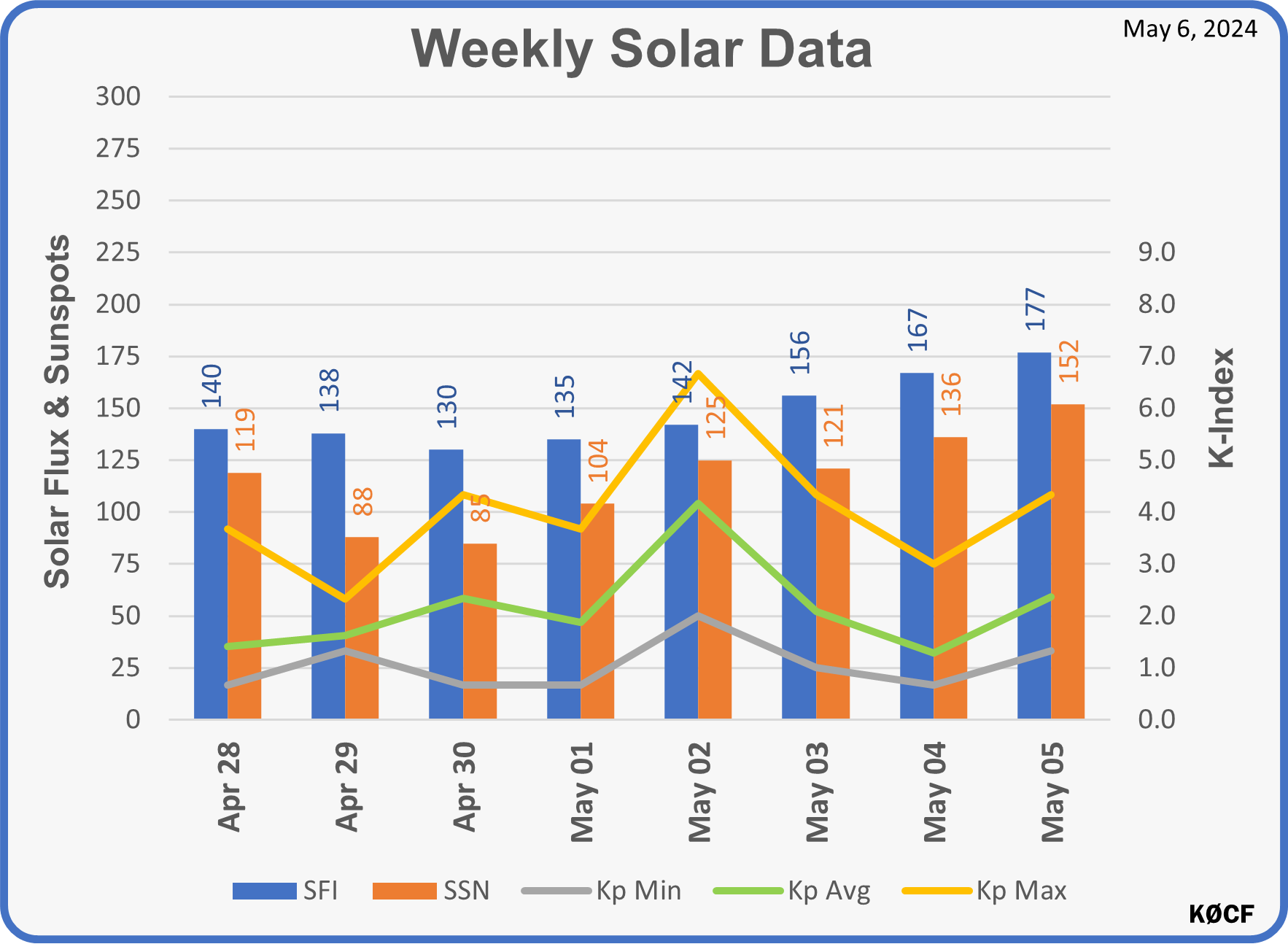
The Weekly Solar Data chart plots Solar Flux Index (SFI), Sunspot number (SSN) and Planetary K-Index (Kp) for the past 8 days. With 8 Planetary K-index readings each day, only the minimum, average and maximum K-index values are plotted. Note: You may click here or on the chart above to see the same data for the past month.
The Daily Solar Flux Index, Sunspot number, Planetary
K-index,
Solar Flux predictions and Solar Flare data used in this bulletin have
been collected by
KØCF from the U.S. Department of Commerce's NOAA
Space Weather Prediction Center.
The propagation graphs above are the creations of KØCF and are unique
in space weather reporting.
Please Note: The graphs are high resolution .PNG files which you may view in greater detail using your browser's "zoom" feature. Alternatively, right click on the graph and select "Open Image in New Tab" to enlarge it, or "Save Image As..." to save it to your computer for further analysis.
|
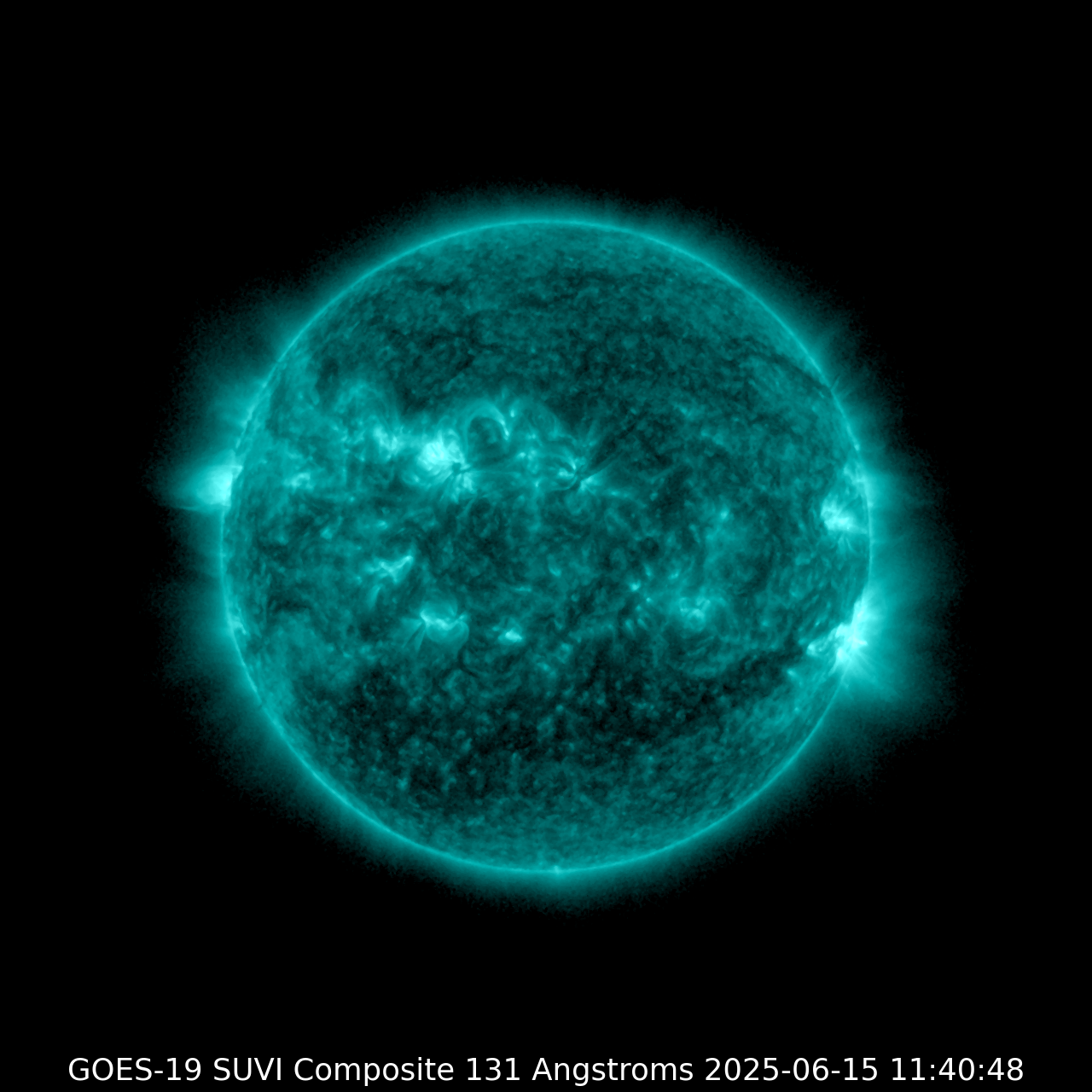
NASA's current view of the Sun at a wave- length of 131 Angstroms. This wavelength shows incredible solar detail. Click here or on the image to view as a full screen 48-hour video loop. It is fascinating! |
 |
Propagation
Summary
For the 8 day period from Thursday, June 18th through Thursday, June
25th.
The average solar flux was 128, up 10 points from the previous week,
with a weekly high of 156 on Thursday, June 25th, following
a low of 111 on June 19th.
The average sunspot count was 90, up 24 from last week,
peaking at 136 on Thursday, June 25th after a
weekly low of 46 on June 18th.
The Planetary K-index weekly average was 3.0 with a
maximum of 5.0 on Thursday, June 25th, indicating
a minor geomagnetic storm.
Solar flare activity since June 19th has been low with 3 major
flares, the largest of which was an M 6.8 event on Sunday, June 21st.
Propagation
Data
Major solar flares, Friday, June 19th through 1423 UTC, June 26th.
| # | Date | UTC | Mag. |
|---|---|---|---|
| 1 | Jun 21 | 1929 | M 6.8 |
| 2 | Jun 20 | 1500 | M 1.1 |
| 3 | Jun 20 | 0151 | M 1.3 |
(NOAA's graph of recent flare activity: GOES-X-Ray-Flux)
From the NOAA Space Weather Prediction
Center,
here are the probabilities of major solar flares and the predicted 10.7
cm Solar Flux for the next 3 days. NOAA updates this information daily.
| Date | M-Flares | X-Flares | Solar Flux |
|---|---|---|---|
| Jun 26 | 50% | 10% | 155 |
| Jun 27 | 50% | 10% | 155 |
| Jun 28 | 50% | 10% | 155 |
Looking farther ahead, here is the NOAA Space Weather Prediction Center forecast of 10.7 cm radio flux and maximum Planetary K-index (Kp) for the next 12 days. This data is updated by NOAA every Monday (last updated on June 22, 2026).
|
|
|
Global
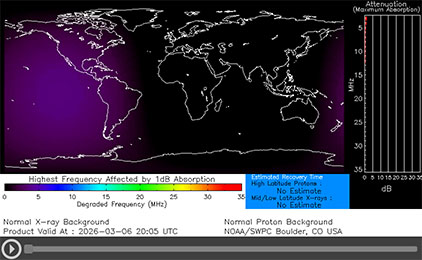
D Region Absorption
Conditions in the D-region of the ionosphere
have a dramatic effect on HF communications. The D-Region Absorption
map combines the effects of solar particles and
photons. Yellow to red colors on the map depict increasing signal
attenuation, where the bar chart at the right displays attenuation
versus frequency. Click the
thumbnail below for an animated map of D-Region Absorption:
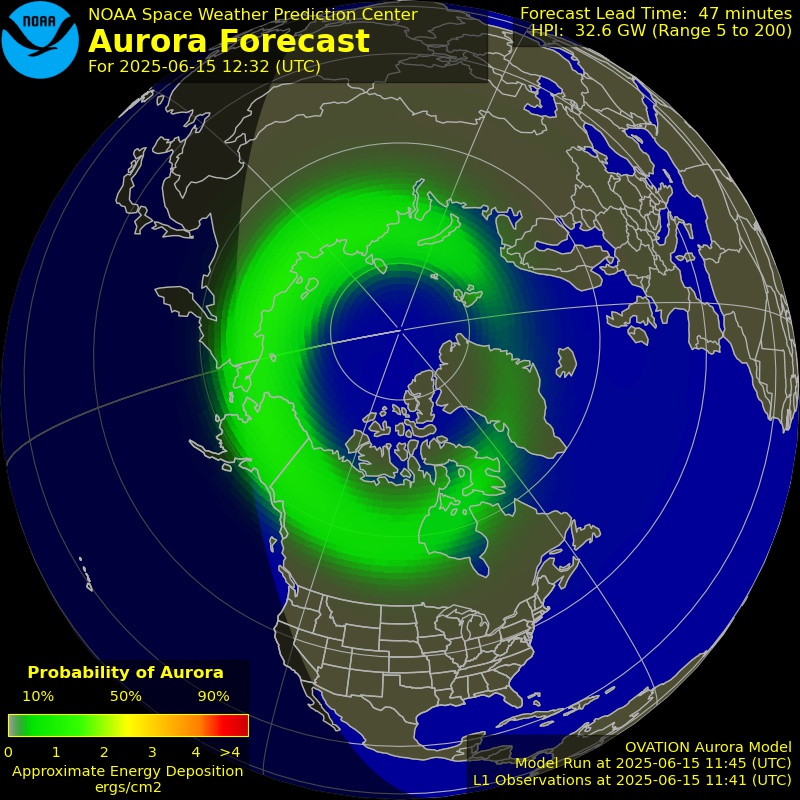
The Aurora
Borealis
The aurora is not only beautiful to see but can have a
profound impact on HF and VHF radio propagation. For the HF operator,
auroras can result in a complete shut-down of propagation. However, on
VHF, auroras present interesting DX possibilities. Beam antennas are
very desirable and should be pointed north, towards the aurora. Signals
are reflected by “back-scatter” and will be distorted with a rough
buzz. SSB is the best voice mode to use, but copy can be difficult. CW
will have a rough buzzy sound but be perfectly copyable. Click the
thumbnail below for an animated map of aurora versus time:
Highs
for Cycle 25
Solar Flux: 336 on
August 8, 2024.
Sunspots: 382 on August
10, 2024.
Popular
Propagation web sites
https://prop.kc2g.com/
(Excellent Maximum Usable Frequency map)
NOAA https://www.swpc.noaa.gov/
https://www.spaceweather.com/
https://www.solarham.com/
https://dx.qsl.net/propagation/
A Propagation
Tutorial
The solar X-ray flux tracks solar activity and solar flares.
Solar
flux, which can vary from as low as 50 to as high as 300, influences
the level of ionization in the F2 region of the ionosphere, providing a
very good prediction of HF DX conditions. The higher the solar flux,
the better conditions will be for the higher HF frequencies and even 6
meters. However, the levels need to be maintained for some days to
allow ionization in the F2 layer to build up. A solar flux of 150
results in good HF band conditions, while levels of 200 and up can
provide great conditions.
Large X-ray flares on the sun can
increase the ionization of the D layer of the ionosphere (a lower
layer) on the sunlit side of the Earth, greatly attenuating or blocking
HF radio transmissions for up to a half hour. Solar flares often
produce Coronal Mass Ejections (CMEs) which, if Earth directed, can
lead to geomagnetic storms. Some large flares are also accompanied by
strong radio bursts that may interfere with other radio frequencies and
cause problems for satellite communication and radio navigation (GPS).
The
Planetary K-index is a measure of the magnitude of geomagnetic storms
and is an excellent indicator of disturbances in the Earth's magnetic
field. A level of 1 or 2 represents quiet geomagnetic conditions; a
reading of 3 or 4 may cause some propagation deterioration; 5 and 6 are
minor to moderate geomagnetic storms; and 7 to 9 are strong, severe,
and extreme storm conditions. Strong geomagnetic storms can trigger
Auroral displays and cause HF radio blackouts. Higher geomagnetic
activity also has the adverse effect of lowering maximum usable
frequencies, much like lower solar flux does.
For
best conditions, the solar flux should be above 150 for a few days with
the K index below 2. When these conditions are met, some good DX is
likely!
(Compiled from information on NOAA.gov and other sources.)
Contest Calendar
Weekly Contests
| Contest | Start UTC | End | Web Site | |
|---|---|---|---|---|
| K1USN Slow Speed Test | Monday | 0000Z | 0100Z | Rules |
| ICWC Medium Speed Test | Monday | 1300Z | 1400Z | Rules |
| Monday | 1900Z | 2000Z | ||
| Tuesday | 0300Z | 0400Z | ||
| CWops Test (CWT) | Wednesday | 1300Z | 1400Z | Rules |
| Wednesday | 1900Z | 2000Z | ||
| Thursday | 0300Z | 0400Z | ||
| Thursday | 0700Z | 0800Z | ||
| Weekly RTTY Test | Friday | 0145Z | 0215Z | Rules |
| NCCC CW Sprint (NS) | Friday | 0230Z | 0300Z | Rules |
Sunday at 7:00 PM in the Central Daylight Saving Time zone, or
Sunday at 6:00 PM in the Central Standard Time zone.
Full Calendar
| Contest | Start | End | Web Site | ||
|---|---|---|---|---|---|
| ARRL Field Day | Jun 27 | 1800Z | Jun 28 | 2100Z | Rules |
| CQ Worldwide VHF SSB/CW Contest | Jul 4 | 1200Z | Jul 5 | 1200Z | Rules |
| IARU HF World Championship | Jul 11 | 1200Z | Jul 12 | 1200Z | Rules |
| CQ Worldwide VHF Digital Contest | Jul 18 | 1200Z | Jul 19 | 1200Z | Rules |
| RSGB IOTA Contest | Jul 25 | 1200Z | Jul 26 | 1200Z | Rules |
| Alabama QSO Party | Jul 25 | 1500Z | Jul 26 | 0300Z | Rules |
| North American QSO Party, CW | Aug 1 | 1800Z | Aug 2 | 0600Z | Rules |
| WAE DX Contest, CW | Aug 8 | 0000Z | Aug 9 | 2359Z | Rules |
| Maryland-DC QSO Party | Aug 8 | 1400Z | Aug 9 | 0400Z | Rules |
| North American QSO Party, SSB | Aug 15 | 1800Z | Aug 16 | 0600Z | Rules |
| NJQRP Skeeter Hunt | Aug 16 | 1700Z | Aug 16 | 2100Z | Rules |
| ARRL Rookie Roundup, RTTY | Aug 16 | 1800Z | Aug 16 | 2359Z | Rules |
| Hawaii QSO Party | Aug 22 | 0400Z | Aug 24 | 0400Z | Rules |
| YO DX HF Contest | Aug 22 | 1200Z | Aug 23 | 1200Z | Rules |
| Ohio QSO Party | Aug 22 | 1600Z | Aug 23 | 0400Z | Rules |
| All Asian DX Contest, Phone | Sep 5 | 0000Z | Sep 6 | 2400Z | Rules |
| CWOps CW Open | Sep 5 | 0000Z | Sep 5 | 2359Z | Rules |
| Tennessee QSO Party | Sep 6 | 1700Z | Sep 7 | 0300Z | Rules |
| MI QRP Labor Day CW Sprint | Sep 7 | 2300Z | Sep 8 | 0300Z | Rules |
| WAE DX Contest, SSB | Sep 12 | 0000Z | Sep 13 | 2359Z | Rules |
| Colorado QSO Party | Sep 12 | 1400Z | Sep 19 | 0359Z | Rules |
| ARRL September VHF Contest | Sep 12 | 1800Z | Sep 14 | 0300Z | Rules |
| North American Sprint, CW | Sep 13 | 0000Z | Sep 13 | 0359Z | Rules |
| Scandinavian Activity Contest, CW | Sep 19 | 1200Z | Sep 20 | 1200Z | Rules |
| Texas QSO Party | Sep 19 | 1400Z | Sep 20 | 2000Z | Rules |
| New Jersey QSO Party | Sep 19 | 1400Z | Sep 20 | 0159Z | Rules |
| Iowa QSO Party | Sep 19 | 1400Z | Sep 20 | 0200Z | Rules |
| New Hampshire QSO Party | Sep 19 | 1600Z | Sep 20 | 2200Z | Rules |
| Washington State Salmon Run | Sep 19 | 1600Z | Sep 20 | 2400Z | Rules |
| Wisconsin Parks on the Air | Sep 19 | 1600Z | Sep 19 | 2300Z | Rules |
| North American Sprint, RTTY | Sep 20 | 0000Z | Sep 20 | 0359Z | Rules |
| CQ Worldwide DX Contest, RTTY | Sep 26 | 0000Z | Sep 27 | 2400Z | Rules |
| Maine QSO Party | Sep 26 | 1200Z | Sep 27 | 1200Z | Rules |
| YU DX Contest | Sep 26 | 1200Z | Sep 27 | 1159Z | Rules |